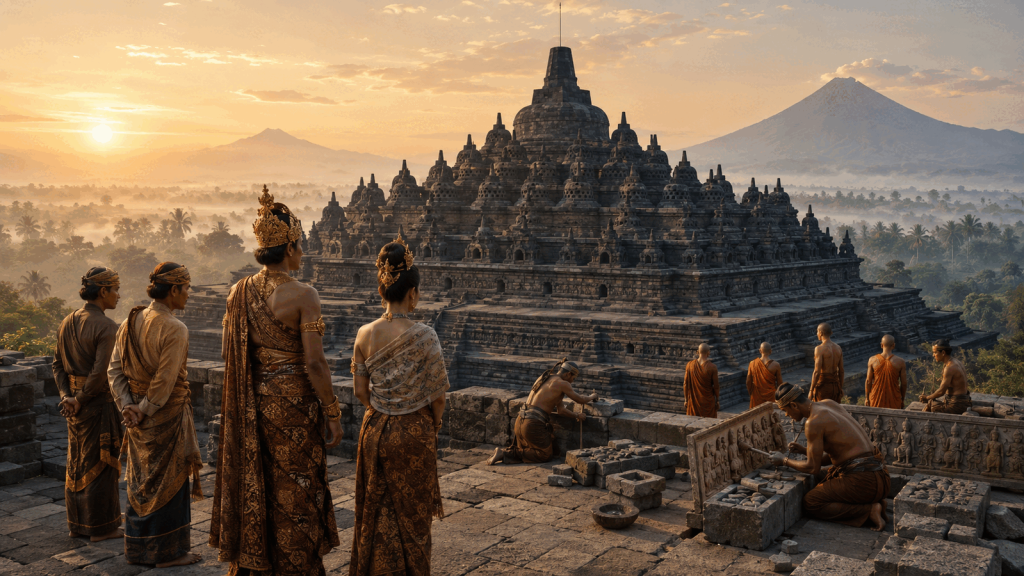

The Sailendra Dynasty Borobudur Temple connection reveals the important role of ancient Javanese rulers in creating one of the world’s greatest Buddhist monuments. Built during the Sailendra period, Borobudur represents the combination of royal ambition, Buddhist philosophy, and advanced architectural knowledge.
The Sailendra Dynasty ruled parts of Central Java during the 8th and 9th centuries. During this period, Mahayana Buddhism developed significantly, and many religious monuments were constructed.
Borobudur became the most remarkable achievement of the dynasty. Temple reflects the spiritual beliefs and cultural strength of the Sailendra rulers.
Sailendra Dynasty and Ancient Java
The Sailendra Dynasty was one of the most influential kingdoms in ancient Java. The rulers supported Buddhism and encouraged the development of religious and cultural projects.
During their reign, Central Java became a center of Buddhist learning and artistic development. The construction of Borobudur demonstrated the dynasty’s commitment to Buddhist traditions.
The rulers used monumental architecture to express religious devotion and political influence. Borobudur became a symbol of their power and spiritual dedication.
Visitors can learn more about this historical period through Borobudur Temple history, origins, rediscovery, restoration, and legacy.
The Construction of Borobudur Under the Sailendra Dynasty
The construction of Borobudur began around the 8th century during the Sailendra Dynasty. Historians believe the project continued for several decades before completion in the early 9th century.
The builders created the temple using volcanic stone from the surrounding region. Millions of stone blocks were arranged carefully to form terraces, stairways, stupas, and relief galleries.
The design followed Mahayana Buddhist cosmology. The monument was divided into three symbolic levels: Kamadhatu, Rupadhatu, and Arupadhatu.
Each level represented a stage of spiritual development. Visitors followed a symbolic path from worldly desires toward enlightenment.
Buddhist Philosophy in Sailendra Architecture
Borobudur reflected the religious ideas supported by the Sailendra rulers. The temple was designed as a sacred journey rather than only a place of worship.
The relief panels displayed Buddhist teachings and stories. These carvings explained moral values, spiritual lessons, and the journey toward enlightenment.
The architecture showed the connection between Buddhist philosophy and ancient Javanese creativity. The monument combined religious meaning with impressive engineering techniques.
King Samaratungga and Borobudur’s Completion
King Samaratungga is often associated with the completion of Borobudur during the early 9th century. Under his leadership, the monument reached its final form.
After completion, Borobudur became an important Buddhist pilgrimage site. Monks and visitors traveled to the temple for meditation and religious activities.
The monument strengthened the position of the Sailendra Dynasty as a major supporter of Buddhism in Southeast Asia.
The Decline of Sailendra Influence
After the decline of Sailendra power, Java experienced major political changes. The center of power shifted, and Buddhist influence gradually decreased.
Borobudur eventually lost its original function and was abandoned for centuries. Natural elements covered parts of the monument, hiding it from wider attention.
The temple was later rediscovered in the 19th century. Restoration efforts helped protect Borobudur and reveal its historical importance.
Borobudur’s Legacy Today
Today, Borobudur remains a symbol of the achievements of the Sailendra Dynasty. The monument represents ancient Java’s religious, artistic, and architectural development.
UNESCO recognized Borobudur as a World Heritage Site in 1991. This recognition confirmed its global cultural importance.
Travelers who want to explore this ancient Buddhist masterpiece can join a Borobudur Temple tour to discover its history, architecture, and spiritual meaning.
Conclusion
The Sailendra Dynasty Borobudur Temple relationship represents one of the greatest achievements of ancient Javanese civilization. The temple reflects the dynasty’s Buddhist beliefs, architectural skills, and cultural vision.
Understanding the Sailendra Dynasty’s role allows visitors to appreciate Borobudur beyond its physical structure. Every stone and relief represents the legacy of a powerful kingdom that shaped Indonesia’s history.